

Fiber vs. Satellite: Which One Actually Works for Rural Internet on the Prairies?
Compare dedicated fiber-to-the-home against satellite Internet on speed, reliability and real-world performance.
Fiber vs. Satellite: Side-by-Side Comparison
An honest technical breakdown for rural Manitoba and Saskatchewan households comparing dedicated fiber-optic Internet to satellite.
| Feature | RFNOW Fiber | Satellite |
|---|---|---|
| Core Technology | Dedicated underground fiber-optic (FTTH) | Geostationary satellite or shared fixed wireless |
| Weather Reliability | Immune — underground cables | ✘ Rain fade, snow & wind outages |
| Typical Latency | 10–30 ms (gaming & video-call ready) | 600 ms+ (noticeable lag on calls) |
| Upload Speeds | Symmetrical — same as download | Fraction of download speed |
| Customer Support | Local technicians | National call centres |
| Property Value | Value increases up to 4.9% with fiber installed | No impact |
| Additional Services | 4K TV and home phone available | Sometimes offer home phone |
RFNOW is an independently owned fiber-to-the-home Internet provider serving rural communities across Manitoba and Saskatchewan. Unlike satellite or fixed wireless providers, RFNOW runs dedicated underground fiber-optic cables directly to each home, delivering low-latency, weather-proof broadband with truly unlimited data and local customer support.
What Makes Fiber Internet Different from Satellite?

Dedicated Line vs. Shared Signal
Satellite and fixed wireless share bandwidth across many users. Fiber-to-the-home runs a dedicated cable directly into your house — delivering city-level speed to the country, with symmetrical upload and download.

Local vs. National Support
National providers route you through call centres. RFNOW hires local technicians who live and work in the same rural communities you do. So any of your questions get resolved faster.

Underground vs. Exposed
Satellite dishes are exposed to rain, snow, and wind. Fiber-optic cables run underground, making them immune to the weather disruptions that commonly knock out satellite connections in rural Manitoba.
We compared every option available in our area. When we looked at reliability, fiber was the clear winner. Now I work from home without my video freezing every time it rains. The difference has been night and day for our family.
Frequently Asked Questions on Fiber vs Satellite
The key difference between fiber Internet and satellite is the distance the Internet signal needs to travel. Satellite signals travel to low earth orbit satellites, taking a bit longer for the signal to travel to your home. Fiber Internet transmits data through advanced underground cables, with much less latency. This means you won’t have lag when doing things like streaming sports, video calls or gaming.
No, RFNOW does not have any data caps or data throttling. RFNOW fiber plans include truly unlimited data with zero caps and zero throttling. By comparison, many satellite and fixed wireless providers reduce speeds after reaching a soft data threshold. This is an important distinction for households that stream, game, video-call, or work from home regularly.
If there is an outage, RFNOW routes support calls to a local Manitoba-based office staffed by technicians in your area, rather than a national call centre. Because the fiber infrastructure is underground and locally maintained, outages are rare compared to satellite. When one does occur, local techs are already nearby and can respond quickly.
The main difference between fiber Internet and satellite Internet is that fiber Internet travels through our blazing fast underground network, delivering speeds up to 1 Gbps symmetrical uploads and no latency or signal lag. Satellite Internet beams radio signals to orbiting satellites, resulting in higher latency, asymmetric speeds, weather-related outages, and data caps. For rural households that need reliable video calls, gaming, or remote work, fiber is the superior choice.
RFNOW is actively expanding fiber-to-the-home across rural Manitoba and Saskatchewan. Enter your address to check availability instantly. New communities are connected regularly, and you can register your interest so you’re notified when service reaches your area.
Yes, satellite Internet can be affected by weather, as the satellite dish that receives the signal can be affected by rain fade, snow buildup, and high winds. Unlike fiber Internet, which has buried and is not affected by normal weather experienced in the Prairies.
How Fiber Internet Works
The Technical Details:
Fiber optic internet uses hair-thin glass fibers to carry data as light signals. Because information literally travels at the speed of light, fiber networks achieve extremely high throughput with minimal signal degradation, even over long distances. According to the fiber Broadband Association, fiber networks can scale to handle growing bandwidth demands for decades without replacing the underlying infrastructure.
What that Means:
At RFNOW, fiber cables are buried approximately 18 inches underground and connected directly to each home or business, a setup known as fiber to the Home (FTTH). This dedicated connection means your speeds aren’t shared with neighbours, and performance stays consistent regardless of how many people in your area are online. Every RFNOW residential fiber plan includes symmetrical upload and download speeds, truly unlimited data with no throttling, and an included eero Pro 6E Wi-Fi router.
How Satellite Internet Works
The Technical Details:
Satellite internet connects your home dish to satellites orbiting the Earth, which relay signals to ground stations. Traditional satellite providers use geostationary satellites positioned roughly 35,000 kilometres above the Earth’s surface. Even newer low-Earth orbit (LEO) constellations like Starlink operate at around 550 kilometres. That distance is the root cause of satellite internet’s biggest limitation: latency.
What that Means:
Every bit of data you send or receive must make that long round trip—from your dish, up to the satellite, down to a ground station, and back again. According to the Federal Communications Commission (FCC), this round-trip delay is an inherent limitation of satellite technology which can’t be changed.
Compare RFNOW vs Xplore and Starlink
The honest truth on choosing between RFNOW Fiber and Xplore or Starlink Satellite
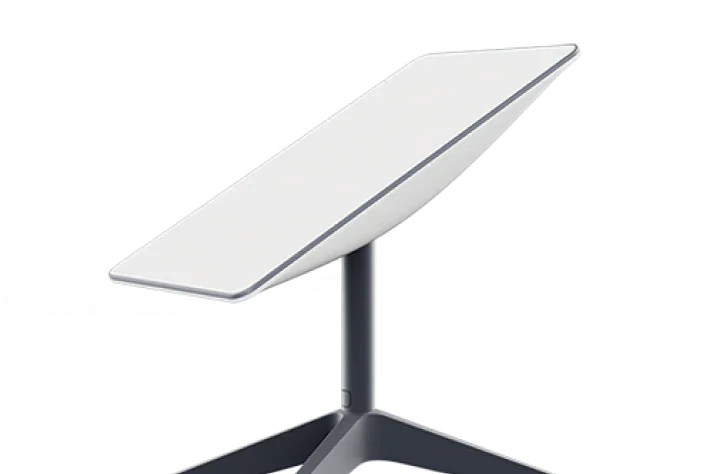
RFNOW Fiber vs Starlink Satellite
RFNOW is great for folks who are concerned about Internet outages due to bad Manitoba weather and want TV and Phone services bundled together. Starlink works well if you aren’t in a fiber area and have more mobile Internet needs.
Read More
RFNOW Fiber vs Xplore Satellite
RFNOW is great for gamers and remote workers who rely on a speedy signal for online activity. Xplore works well if you aren’t in a fiber area.
Read MoreSpeed and Latency: Why Fiber Is Dramatically Faster
Speed is the most visible difference between fiber and satellite, and the gap is substantial. Fiber internet plans commonly offer 1 Gbps symmetrical speeds, with some providers now delivering 5 Gbps or even 10 Gbps. Satellite services typically deliver between 50 and 250 Mbps downloads, with upload speeds limited to 5–25 Mbps.
But raw speed only tells part of the story. Latency, or the time it takes for data to travel from your device to a server and back, matters just as much for real-time activities. Fiber connections typically achieve latency between 1 and 10 milliseconds. Starlink’s LEO satellites offer latency of roughly 20–50 ms, which is a massive improvement over traditional satellite’s 600+ ms, but still noticeably higher than fiber.
That latency gap has real consequences. In competitive online gaming, even 30 ms of additional delay can be the difference between a win and a loss. On video conferences, higher latency causes the awkward pauses and audio overlap that make remote meetings frustrating. For RFNOW business customers who rely on real-time applications like VoIP, cloud-based tools, and video conferencing, fiber’s near-zero latency is a genuine operational advantage.
According to Ookla’s Speedtest Global Index, fiber connections consistently rank among the fastest and most consistent broadband technologies worldwide, far outpacing satellite in both median download speed and latency.
Reliability: Fiber Doesn’t Care About the Weather
Reliability is where the structural differences between these technologies become most apparent. Fiber cables are buried underground or run along poles, completely shielded from atmospheric conditions. Rain, snow, wind, and cloud cover have zero effect on your fiber connection. The only realistic threat to fiber reliability is physical damage to the cable itself (such as from construction equipment) which is relatively rare.
Satellite connections, on the other hand, depend on a clear signal path between your dish and satellites in orbit. Heavy rain, snow, and dense cloud cover can all degrade or interrupt the signal, a phenomenon commonly known as “rain fade.” For households in Manitoba and Saskatchewan, where winter storms and unpredictable weather are a reality, this is a meaningful concern.
The Canadian Radio-television and Telecommunications Commission (CRTC) has noted that fixed broadband technologies like fiber consistently outperform satellite and wireless connections in reliability metrics. RFNOW’s buried fiber network is specifically designed to withstand harsh prairie conditions, and because RFNOW owns and operates its own infrastructure, outages can be resolved quickly by local crews.
Who Should Choose Fiber Internet?
If fiber is available at your address, it’s almost certainly the better choice. Here’s why fiber makes sense for different types of people:
- Households with Multiple Users and Devices
- Remote Workers and Video Conferencing
- Gamers and Streamers
- Businesses That Depend on Connectivity
When Does Satellite Internet Make Sense?
Satellite internet serves an important purpose for locations that fiber infrastructure hasn’t yet reached. If you live in an extremely remote area with no access to wired broadband of any kind, satellite may be your only option for getting online. It’s also useful for temporary or mobile setups (such as construction sites, research stations, or RV travel) where running a physical cable isn’t practical.
However, as fiber networks expand into more rural communities, the areas where satellite is the only option are shrinking. RFNOW is actively investing in rural fiber projects across Manitoba and Saskatchewan, including underserved and First Nation communities, with the goal of bridging the digital divide.
The Bottom Line: Fiber Is the Better Choice When It’s Available
In almost every category that matters: speed, latency, reliability, data limits, and cost, fiber internet outperforms satellite. While satellite technology has improved significantly in recent years, particularly with LEO constellations, it still cannot match the performance, consistency, and value that fiber delivers.
For homes and businesses across rural Manitoba and Saskatchewan, RFNOW is making fiber internet a reality. With a locally owned and operated network, Canadian-based customer support available seven days a week, and plans that include all equipment with no hidden fees, RFNOW delivers the connection rural communities deserve.
Ready to experience the difference fiber makes? Explore RFNOW residential fiber plans or discover business fiber solutions today.
Join the many customers who made the switch to fiber internet and stopped stressing about satellite service. Find out if you are in our coverage area.